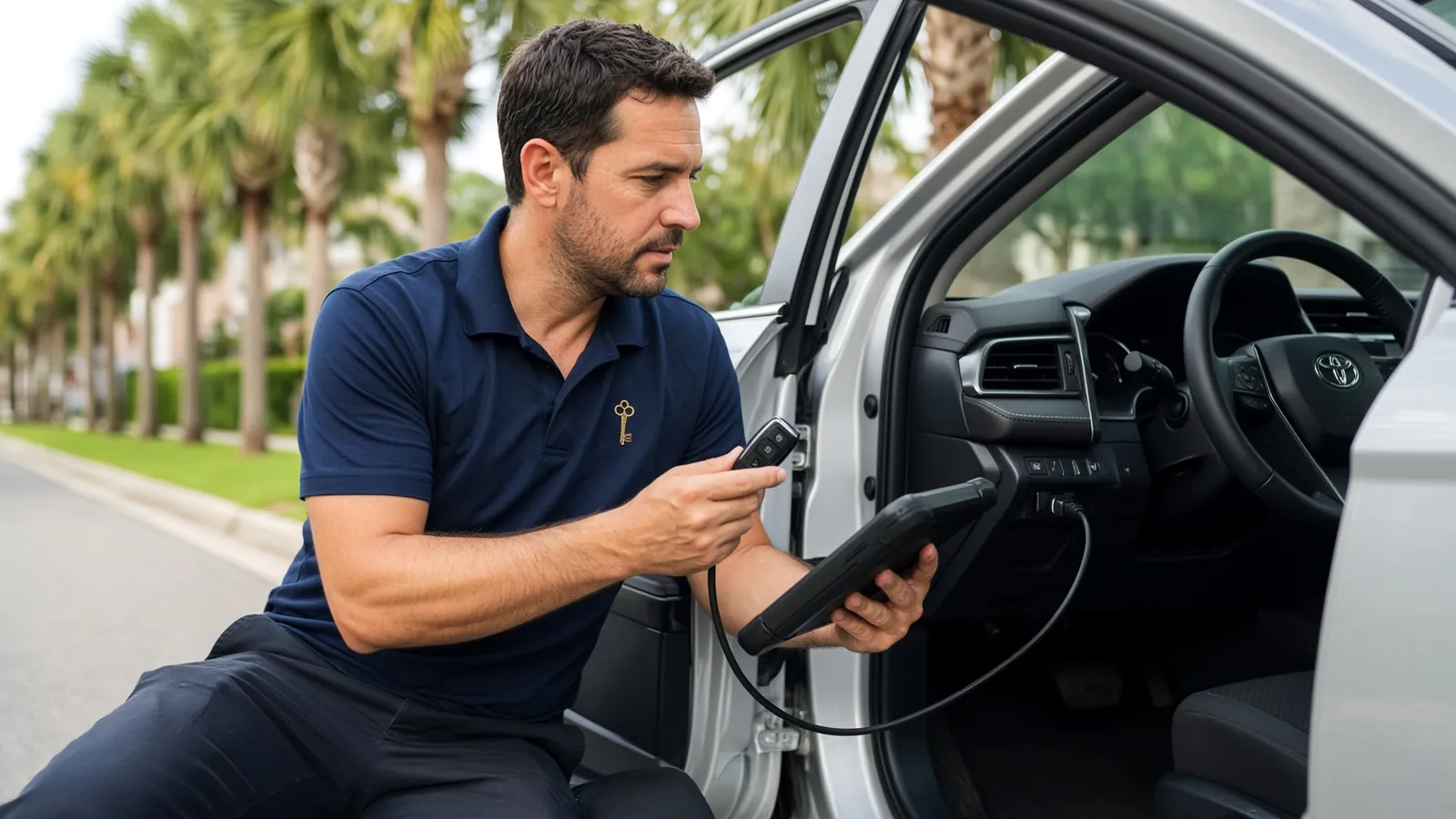
Transponder key programming
New key, spare key, or no key left at all, we cut it and teach your car to accept it on site. Most non-German makes, with the total price given on the phone first.
Prefer to write? Send a quote request
Quick answer
Car key programming is how your car learns to trust a new key. A chip in the key head sends a code, and the car only lets the engine run if that code is on its list. In Port St. Lucie, we add new transponder keys and fobs to that list on site, erase lost ones where the car allows, and quote the total first.
Lock and car brands we work on
Car key programming in Port St. Lucie usually means one of two jobs: adding a new key to a car that already has a working one, or starting over when every key is gone. Either way, the goal is the same. Your car’s security computer keeps a short list of keys it will accept. Programming puts your new key on that list.
The work happens wherever the car is, from your driveway in Port St. Lucie to an office lot in Stuart. We cut the metal blade first, so the key fits the door and ignition. Then we connect to the car, put it into its key-learning mode, and register the new chip. Last, we prove it works with a full engine start and a test of every button.
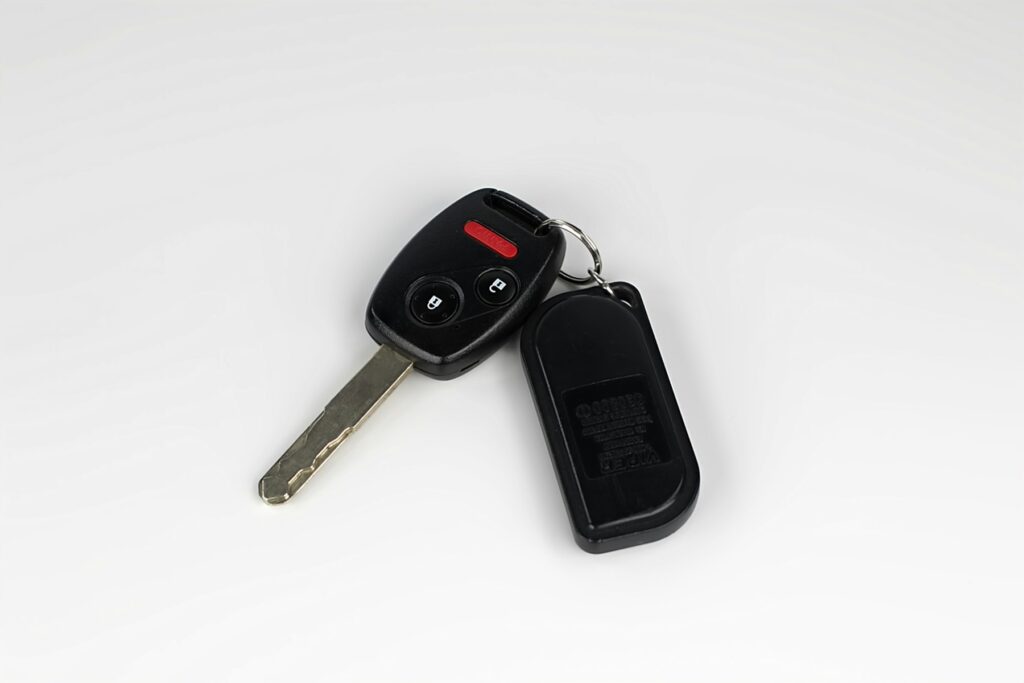
It reads a code from a tiny chip in your key and checks it against the codes it has stored. The chip, called a transponder, has no battery. When you turn the key, a ring-shaped antenna around the ignition sends out a small electromagnetic field. That field powers the chip just long enough for it to answer with its code.
If the code matches, the engine computer lets the fuel injection run. If it doesn’t, the engine won’t run. On Ford’s version, called SecuriLock or PATS, a wrong code keeps the fuel pump and the starter switched off.
Early chips sent the same fixed code every time, which made them easier to copy. Later systems use rolling codes or real encryption, so the practical fix is to program a new key to the car instead of trying to copy an old one. This is also why immobilizers matter. NHTSA says they stop thieves from bypassing the ignition, and more than 650,000 vehicles were still stolen in the U.S. in 2025.
Keys cut and programmed at the car, no tow needed.
Some Hyundai and Kia models from the 2011 to 2022 model years left the factory without an engine immobilizer, and both makers later released anti-theft software to cut down on thefts. When you give us your VIN, we check what your key actually needs before we quote.
Which one we use depends on the make, the year, and how many working keys you still have.
Some cars let the owner add a key with a set of key turns and button presses from the manual. The catch is that most need two working keys already. Ford’s PATS II system, for example, won’t accept a new key without two that already work.
This is the most common locksmith method. A programming tool plugs into the port under the dash and talks to the car’s security module. It only works when the car allows secure access, and some makers require security data from the manufacturer first.
Some cars build in a long wait. When every key is lost on many 2017 to 2019 GM vehicles, the car runs a 30-minute learn procedure. Once it finishes, every key the car knew before stops working.
When the port route is blocked, the key data may have to be read straight from the immobilizer, the engine computer or the body control module. It takes longer and needs more care, so we explain it before we start.
It depends on what is failing. Tell us what the car does when you try the key, and we can usually narrow it down. Here is how we tell the cases apart:
Many newer keys have a wavy groove cut down the middle of the blade instead of notches along the edge. These are called laser cut or sidewinder keys. The design is harder to pick, and copying one takes a specialized, expensive cutting machine. We cut these as part of car key replacement, and the cutting itself takes only a few minutes before the programming starts.
Call and we will quote the total before we drive out. Sun to Thu 7am to 11pm, Fri 7am to 5pm.
For many makes, it comes from the carmaker through a system run by NASTF, the National Automotive Service Task Force. NASTF is a non-profit set up in 2000. It doesn’t hand out codes itself. It checks out locksmiths and repair shops, then gives them access to the security data that carmakers release.
Locksmiths who use it register as Vehicle Security Professionals. That takes a criminal background check plus proof of business insurance and a bond. Each security job is tied to paperwork with the owner’s driver license and the car’s registration, title or insurance, and that paperwork has to be filed within 5 days. So when we ask for your ID and papers, it isn’t red tape. It is how the system keeps car keys out of the wrong hands.

The cheapest time to get a spare is while you still have a key that works. On many 2017 to 2019 GM vehicles, the quick way to add a key needs two working keys, and with only one, GM's own service software has to be used. Losing your last key turns a short visit into an all-keys-lost job.
We need proof the car is yours before we make any key. Have these ready when we arrive:
Typical ranges are below. Your exact total is quoted on the phone before we drive out, based on your car and how many keys you have left.
| Job | Typical range | What is included |
|---|---|---|
| Transponder key, cut and programmed | $150 to $275 | Blade cut, chip added to the car, engine start tested |
| Remote head key or smart key, programmed | $200 to $400 | Key or fob, programming, and every button tested |
All-keys-lost jobs usually land higher in the range than adding a spare. Full list on our pricing page, or request a quote online.
We program keys for most Japanese, Korean and American makes, from Toyota and Honda to Ford, Chevrolet, Jeep, Ram, Hyundai and Kia. Every make we cover, plus lockouts and ignition work, is listed under car locksmith services.
German brands are not on that list. We don’t program keys for BMW, Mercedes-Benz, Audi, Volkswagen, Porsche or Mini, so please call a dealer or European specialist for those. A few brand-new models of other makes also need dealer-only access, and we will tell you on the phone if yours is one of them.
Other services
Other locksmith services from the same team, with the same rule: total price on the phone first.

Locked out of a house, car or business. Damage-free entry first, proof of ownership every time.
Deadbolts, knobs, sliders and storm doors fitted and repaired at your home.

New pins so old keys stop working, or new hardware when the lock is worn out.
Keypad and Wi-Fi deadbolts fitted, aligned and set up with your codes.

Remote head keys, flip keys and push to start fobs, programmed on site.

Storefront and office locks, closers, panic bars and staff change rekeys.
Master key systems, keypads and fob readers for offices and rentals.
FAQ
Sometimes. Some cars have an owner procedure in the manual, but Consumer Reports notes most of them need two working keys before they will accept a new one. With only one key, or none, the car needs a programming tool. That is the point where a locksmith or the dealer comes in.
The programming step is often short. Consumer Reports puts dealer fob programming at 15 to 30 minutes. Some cars add a built-in wait, like GM's 30-minute security learn when every key is lost, and cutting the blade adds a few minutes. Once we know your car, we give you a realistic time on the phone.
Keys you still have can usually stay on the car's list if they are with you when we program. Keys you don't have can be erased where the car allows it. Some systems wipe every old key during an all-keys-lost job, like GM's 30-minute procedure, so bring every key you own to the appointment.
Usually not, so ask before you spend money on one. Chrysler, Dodge and Jeep chips are locked to the first vehicle they are programmed to. Used Toyota smart keys are flagged as used, and standard tools refuse them. Ford's integrated keys are one exception and can be programmed more than once.
The blade was copied, but the car doesn't recognize the chip. If the copy has no chip, or a chip that was never added to your car, the immobilizer won't let the engine run. The key may still open the doors. Programming a proper chip key to your car fixes it.
No. Some makes need security data from the manufacturer before a key can be added, but you don't have to track it down. Getting it is part of the job. It is also one reason we ask for photo ID and registration first, because that kind of data is only released after ownership is checked.
Yes. A spare made while one key still works is the simplest and lowest-cost version of this job. If you lose your only key, you are into entry, blade decoding and an all-keys-lost procedure. On some cars you also need two working keys just to add more later. One spare in a drawer avoids most of that.

Ready when you are
Tell us what happened and where you are in Port St. Lucie and the Treasure Coast. You get the total price on the phone before anyone drives out.


